What if your car gave you one last warning before leaving you stranded?
A dying battery rarely fails without a trace-it usually sends signals through slow starts, dim lights, dashboard warnings, and strange electrical behavior.
Knowing these early signs can help you replace the battery before it fails in a parking lot, during your morning commute, or on the coldest day of the year.
Here’s how to spot the warning signs your car battery is about to die-and what to do before it leaves you stuck.
What a Weak Car Battery Does Before It Fails: Early Warning Signs Drivers Should Know
A weak car battery usually gives small warnings before it leaves you stranded. The most common sign is a slow engine crank, especially first thing in the morning or after the car has been parked for several hours. If the starter sounds tired but the engine eventually turns over, the battery may be losing cold cranking power.
Electrical issues are another early clue. You may notice dim headlights at idle, flickering dashboard lights, a weak horn, or power windows moving slower than usual. In real-world repair shops, drivers often report “random” warning lights, only to find the battery voltage is unstable and confusing the vehicle’s electronics.
- Check engine or battery light: This can point to low voltage, a charging system problem, or alternator stress.
- Clicking sound when starting: Often means the battery does not have enough power to engage the starter properly.
- Frequent jump starts: If you need roadside assistance more than once, replacement is usually more cost-effective than waiting.
A simple battery test can prevent a surprise towing bill. Many auto parts stores and repair shops use tools like the Midtronics battery tester to measure voltage, cranking amps, and overall battery health. You can also use a digital multimeter at home; a healthy fully charged 12-volt battery typically reads around 12.6 volts with the engine off.
One practical example: if your car starts fine after a long drive but struggles the next morning, the battery may not be holding a charge overnight. That is a strong reason to schedule a car battery replacement service before the problem becomes an emergency.
How to Confirm a Dying Car Battery: Starting Problems, Dim Lights, Dashboard Alerts, and Voltage Checks
The most reliable way to confirm a dying car battery is to compare symptoms with a quick voltage test. If the engine cranks slowly, clicks once, or starts fine in the morning but struggles after work, the battery may no longer hold a proper charge-especially in cold weather or after short city trips.
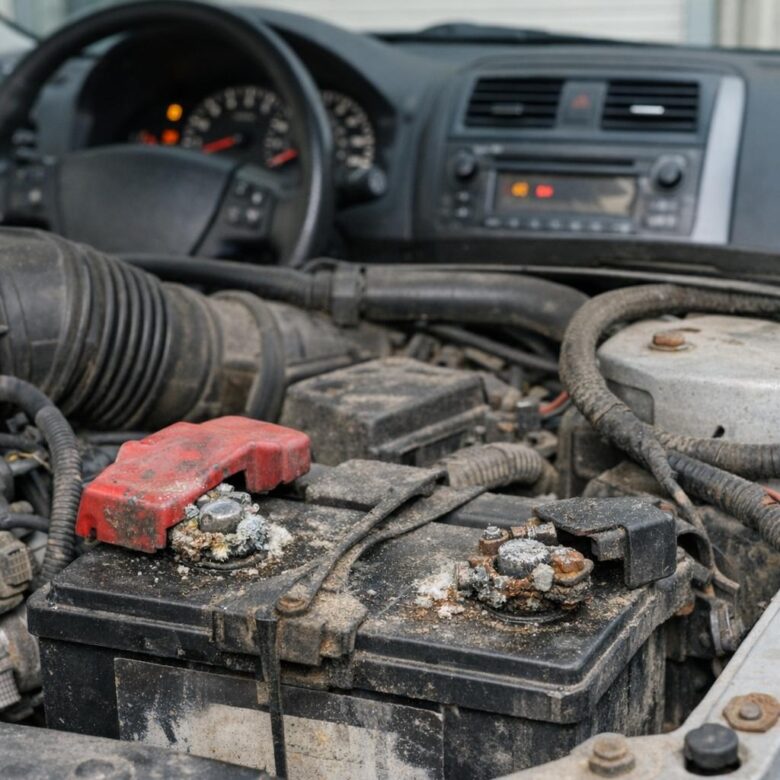
Look for supporting clues before paying for battery replacement service. Dim headlights, weak interior lights, a slow power window, or a flickering dashboard can point to low battery voltage, but they can also be caused by corroded terminals or a failing alternator. I’ve seen perfectly good batteries act “dead” simply because the negative terminal was loose after a recent oil change.
- Starting issue: slow crank, repeated clicking, or no crank at all.
- Electrical warning signs: battery light, dim lights, random dashboard alerts, or weak accessories.
- Voltage check: use a digital multimeter or a tester like the ANCEL BA101.
With the car off, a healthy fully charged battery is usually around 12.6 volts. Around 12.2 volts suggests a low charge, while anything near or below 12.0 volts needs attention. After starting the engine, voltage should typically rise because the alternator is charging; if it does not, ask an auto repair shop to run a charging system diagnostic.
Many auto parts stores offer free car battery testing, which is useful before spending money on a new AGM battery, roadside assistance, or mobile battery installation. Testing first helps you avoid replacing the wrong part.
Replace, Recharge, or Keep Driving? Avoiding Costly Mistakes When Battery Symptoms Appear
When battery warning signs show up, the expensive mistake is guessing. A slow crank after a cold night may only need a full recharge, while repeated no-starts after short drives often point to a weak car battery that will leave you stranded again.
Start with a basic battery test, not a new purchase. Many auto parts stores and repair shops use professional battery testers like Midtronics to check voltage, cold cranking amps, and charging system performance; this is far more useful than judging by headlights or dashboard lights alone.
- Recharge if the battery is fairly new and was drained by lights, a dash cam, or sitting unused.
- Replace if it fails a load test, is swollen, leaking, or struggles even after a proper charge.
- Keep driving cautiously only if the battery tests healthy and the issue points to loose terminals or corrosion.
A real-world example: if your SUV starts fine after a jump but dies again the next morning, buying a portable jump starter may help temporarily, but it does not fix the root problem. You need to test both the battery and alternator before spending money on battery replacement, roadside assistance, or unnecessary electrical diagnostics.
Also consider your driving pattern. Short city trips, extreme heat, and frequent phone charging can drain a marginal battery faster than expected, so a smart battery charger or maintainer is often worth the cost for vehicles parked for days at a time.
The Bottom Line on Signs Your Car Battery Is About to Die
A weakening battery rarely fails at a convenient time, so the smartest move is to act before it leaves you stranded. If your car is slow to start, electrical behavior seems unusual, or the battery is near the end of its expected life, don’t wait for a complete failure.
- Test it early: A quick voltage or load test can confirm its condition.
- Replace when doubtful: Preventive replacement is cheaper than emergency towing.
- Check related parts: Make sure the alternator and terminals are not the real issue.
When reliability matters, a questionable battery is not worth gambling on.