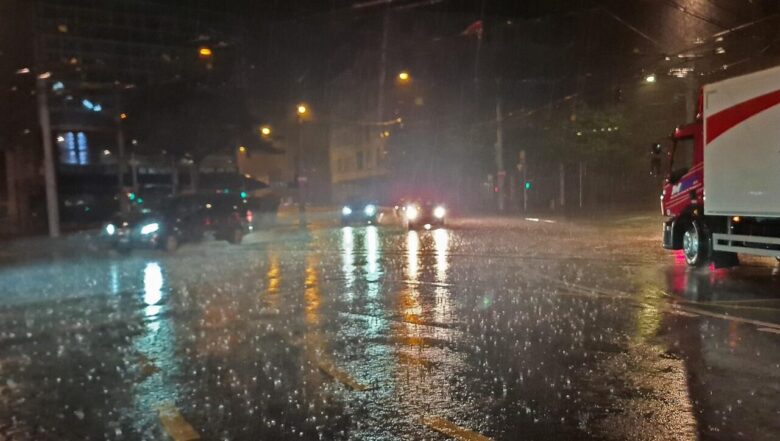
Heavy rain can reduce contrast, hide lane markings, increase tire spray, and leave enough water on the road to disrupt traction. Safe driving therefore depends on what you can see, how the vehicle responds, and whether the road remains passable—not on one universal speed reduction.
Let Visibility and Traction Set the Pace
A posted speed limit describes the maximum permitted speed under applicable rules; it is not a promise that the same speed is appropriate in heavy rain. Rain intensity, road shape, standing water, tire condition, traffic, lighting, and vehicle behavior can all require a greater reduction.
Use the following signs to judge whether your current pace is manageable:
- You can identify lane markings, road edges, brake lights, and stopped traffic with enough room to respond gradually.
- The steering feels consistent rather than unusually light or vague.
- The tires are not repeatedly tugging, slipping, or losing contact through patches of water.
- You can brake and change direction without abrupt inputs.
- Spray from surrounding traffic is not obscuring the route ahead.
If any of those conditions deteriorate, ease off the accelerator and reduce speed smoothly. Avoid sharp steering, sudden acceleration, and unnecessary lane changes. Allow extra room before curves, intersections, work zones, and low areas where water may collect.
Do not assume that all-wheel drive, traction control, or electronic stability control removes the risk. These systems may help in certain situations, but they cannot create grip where the tires cannot maintain useful contact with the road.
Heavy-Rain Decision Matrix
This matrix is a condition-based guide rather than a universal speed or distance formula. Local traffic rules, road closures, warning signs, and official emergency instructions take priority.
| What you observe | Appropriate response | Reason to stop or change route |
|---|---|---|
| Wet pavement with clear lane markings and stable steering | Reduce pace as needed, increase space, and use smooth controls. | Conditions begin worsening faster than you can safely adapt. |
| Heavy spray, glare, or intermittent loss of lane detail | Slow progressively, avoid passing where spray blocks the view, and create more space. | You cannot consistently identify the lane, road edge, or traffic ahead. |
| Water collecting in wheel paths or across part of the lane | Reduce speed before reaching it, keep steering steady, and avoid abrupt braking in the water. | Depth, road condition, or a safe path through the water cannot be confirmed. |
| Steering becomes light, engine speed changes unexpectedly, or the vehicle drifts | Ease off the accelerator, look toward the intended path, and avoid sudden control inputs. | Traction does not return promptly or similar patches continue across the route. |
| Flood warning, closure, moving water, or submerged road features | Do not enter. Turn around or use an officially recommended alternative. | The road is closed, flooded, washed out, or its condition is unknown. |
| Visibility is shorter than the distance needed to respond and stop | Leave the roadway at a safe parking area, rest area, or other location separated from moving traffic. | No safe travel pace allows you to see and react in time. |
Increase Space Without Treating One Second Count as Universal
A time-gap method can help drivers notice when they are following too closely, but one fixed count cannot account for every vehicle or storm. A loaded vehicle, worn tires, downhill grade, poor pavement, limited visibility, and traffic spray may all require substantially more room.
Choose enough space to let you slow progressively if the vehicle ahead brakes, encounters water, or changes lanes suddenly. Increase that margin until you can see beyond the vehicle where possible and respond without relying on a panic stop.
More space is particularly important when:
- A truck, bus, or other large vehicle is producing heavy spray.
- You are approaching a curve, crest, intersection, or downhill section.
- Traffic is compressing or brake lights are appearing farther along the road.
- Lane markings disappear under water or glare.
- Your vehicle is carrying a heavy load or towing within manufacturer limits.
- The tires, brakes, or visibility equipment may not be performing normally.
Watch traffic well beyond the nearest vehicle when visibility permits. Early awareness supports smoother braking and reduces the need for sudden steering. If another driver moves into the gap, restore space gradually rather than braking aggressively.
Standing Water Changes the Risk Quickly
Standing water can cause a tire to lose useful contact with the pavement. The likelihood depends on several interacting factors, including speed, water depth, tread condition, tire design, inflation, road surface, and vehicle load. There is no single speed at which hydroplaning always begins.
If the vehicle starts to lose traction
Keep your eyes on the intended path, hold the steering wheel steadily, and ease off the accelerator. Avoid abrupt braking or sharp steering while the tires are struggling for grip. Once normal steering response returns, continue slowing smoothly and reassess whether the route remains safe.
If hard braking becomes necessary, follow the braking guidance in the owner’s manual. Vehicles with anti-lock braking systems are generally designed for firm, continuous pedal pressure rather than manual pumping, but control behavior and driver instructions can vary by vehicle.
Driver-assistance and cruise-control features should be used only under the conditions permitted by the vehicle manufacturer. Heavy rain, poor lane visibility, and standing water may prevent these systems from operating as expected. Take manual control when conditions exceed the system’s stated limits.
Floodwater is a different hazard
Do not use another vehicle’s successful crossing as proof that a flooded section is safe. Vehicles differ in clearance, intake placement, weight, tires, and water resistance. Water may also conceal debris, missing pavement, open drains, or a current that is not obvious from the driver’s seat.
Obey barriers and closure signs, and do not enter moving water or a roadway whose surface cannot be assessed. Follow local authority and emergency-management instructions when flooding affects the route.
If a vehicle stalls in water, do not repeatedly attempt to restart it. If remaining in place creates immediate danger, contact emergency services and follow their instructions. Leave the vehicle only when doing so is clearly safer than staying inside; moving water, traffic, electrical hazards, and unstable ground can make self-evacuation dangerous.
Tires, Wipers, Lights, and Defogging Affect What You Can Safely Manage
Basic checks can identify visible problems before departure, but they cannot guarantee wet-road grip or safe passage through severe weather.
Tires
- Inspect the tread for obvious wear, embedded objects, cuts, cracks, or bulges.
- Check pressure when appropriate using the vehicle placard and owner’s manual. Do not substitute the maximum pressure molded on the tire sidewall for the vehicle manufacturer’s normal inflation specification.
- Consider vehicle load and towing requirements listed by the manufacturer.
- Do not assume a warning light is the only indication of a pressure problem.
Tread requirements and inspection rules vary by jurisdiction. If tread is worn, wear is uneven, a tire is damaged, or pressure will not remain stable, avoid demanding wet-weather travel and have the tire assessed by a qualified tire professional.
Wipers and windshield visibility
Wipers that leave broad streaks, skip across the glass, or fail to clear the driver’s view may need cleaning, adjustment, or replacement with parts suitable for the vehicle. Keep the windshield and washer system clean and verify washer-fluid requirements in the owner’s manual.
For interior fogging, select the vehicle’s windshield-defogging mode and follow the climate-control instructions in the manual. Fresh airflow and air conditioning may help remove moisture, while the temperature can be adjusted for comfort and effective clearing. Do not continue if the windshield cannot be kept clear.
Lights
Use the lighting required by local law and appropriate for the conditions. Low beams generally provide better forward visibility in rain than high beams, which can increase reflected glare. Automatic daytime lighting may not activate every lamp needed for poor visibility, including rear lights, so confirm how the vehicle’s lighting system operates.
Checking lamps, wipers, glass, and visible tire condition is a low-risk pre-trip task when the vehicle is parked safely. Electrical faults, repeated lamp failures, damaged tires, steering changes, brake concerns, or wiper-system failures warrant assessment by a qualified professional. Do not inspect a vehicle beside fast-moving traffic when a safer location or roadside assistance is available.
Know When Conditions Justify Leaving the Road
Slowing down is not always enough. Stop driving when no reasonable pace provides a clear view and adequate control, or when official warnings indicate that the route should not be used.
Conditions that justify finding a safe place off the roadway include:
- Lane markings, road edges, traffic signals, or stopped vehicles cannot be identified reliably.
- The vehicle repeatedly loses traction or feels unstable despite a substantial reduction in pace.
- Water covers the route and its depth or the condition of the pavement is unknown.
- Wipers, lights, tires, steering, brakes, or defogging are not functioning well enough for the conditions.
- A flood warning, road closure, or instruction from local authorities affects the route.
- Fatigue, stress, or poor visibility is preventing sustained attention.
Whenever possible, use a parking lot, rest area, service area, or another location separated from moving traffic. A shoulder may expose occupants to passing vehicles and should not be treated as the preferred waiting place when a safer option is reachable.
If the vehicle must stop because it cannot be driven safely, make it visible in accordance with the owner’s manual and local rules. Hazard-light use while moving or stopped varies by jurisdiction. Do not stand outside near active lanes, and do not place warning equipment unless it can be done without entering traffic or floodwater.
Call roadside assistance for a disabled vehicle when it is safe to remain in place. Contact emergency services for an immediate threat involving floodwater, a collision, injury, fire, or a vehicle stopped in a dangerously exposed location. Resume the trip only after visibility, road access, and vehicle control have improved enough to support safe travel.

The Cars Cola Coins Editorial Team publishes practical, beginner-friendly content about car maintenance, fuel efficiency, road safety, vehicle ownership, and everyday automotive decisions. Our guides are prepared for general educational purposes, with a focus on clear explanations, realistic maintenance practices, and accessible information for drivers with different experience levels. The content does not replace vehicle inspection, diagnosis, or repair by a qualified automotive professional.